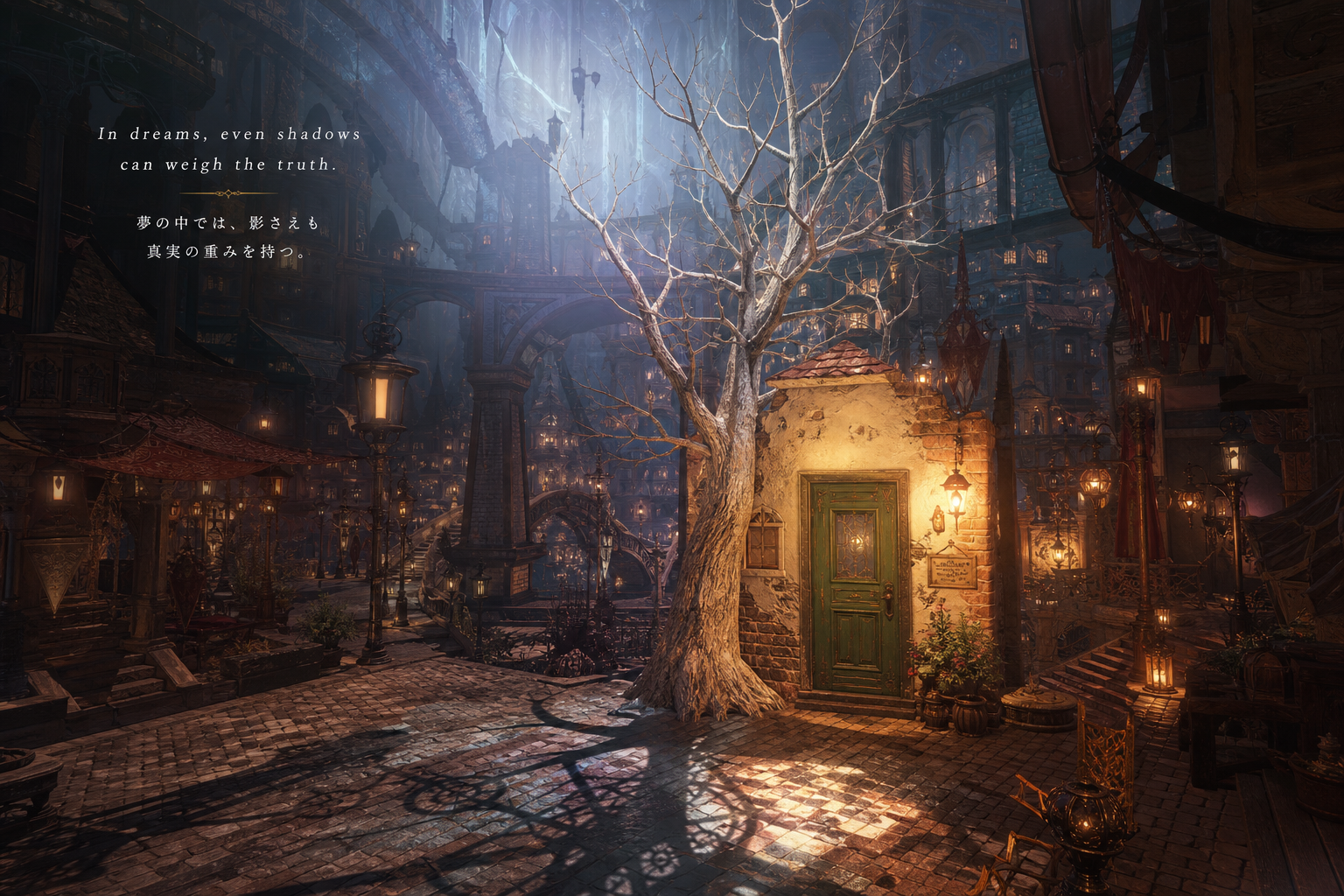
— The First Waking —
The smell reaches you before anything else.
Cardamom and hot copper and something underneath both — older, like rain on stone that hasn't seen
rain in a century. Your cheek is resting against a surface. You lift your head.
Tile. Mosaic tile, the small hexagonal kind, arranged in a pattern that might be waves or might be
scales, blue-green and chipped at the edges. You are on a floor. The floor is warm.
You sit up.
The arcade stretches in both directions — a long, vaulted corridor of pale stone, its ceiling lost
in shadow except where oil lamps hang on iron chains, throwing pools of amber light that almost
touch. Between the pools: a soft, purple dark. Stalls crowd the walls on either side — folded
fabric, stacked clay jars, a glass case holding something that glows without a source. Everything
is closed. Everything is sleeping.
Beyond the end of the arcade, through an arch that is trying to be three architectural styles
simultaneously, you can see the wider city. Layered, impossible, and very much awake. Distant
voices. A bright thread of neon — blue-white — slicing between what looks like a medieval buttress
and something that might be a greenhouse. Lamplight on water. A cart wheel turning.
You don't know how you came to be here.
You know your name. Oros. You know the weight of your own hands, the slight ache in your left
shoulder that has been there so long you've stopped wondering why. You know other things — smells,
faces, fragments of rooms — but when you reach for the one thing that should anchor you, the
central fact, the inheritance, the reason —
Nothing. A door that opens onto another door that opens onto dark.
Someone has left a clay cup of tea near where you were lying. It is still warm.
··┄── ✧ ──┄··
[Oros] I lift the cup in both hands. I feel its warmth. I take a sip. As soon as I regain my
senses, I will arise and retake what is mine.
··┄── ✧ ──┄··
The tea tastes of cardamom and something else — something sweet at the back of the throat that you
almost recognize. Not quite honey. Not quite anise. The warmth of it travels through your chest
with unusual deliberateness, as if it knows where to go.
You are sitting on the edge of a low stone fountain basin. The fountain itself is dry — Art Deco
curves in pale green marble, a stylized fish frozen at the lip — but the air smells faintly of
water, as though it recently ran. Around you, the arcade stretches in both directions: vaulted
arches of pale brick, oil lamps burning amber, stalls shuttered in wood and canvas. The mosaic
beneath your feet shows figures in procession, their faces worn smooth by decades of feet that
should not have passed this way.
Retake what is mine.
The certainty is there. The content is not. You know with bone-deep conviction that something was
taken — or that something waits — but the name of it, the shape of it, the face — all absent, like
a word that will not come.
The arcade is not empty. Forty feet away, something moves at the edge of lamplight: a figure in a
long coat, kneeling at the junction where your arcade meets another corridor. They are holding a
sheet of paper against the mosaic floor, making marks. The sound of their pen is the only sound
that is not the lamps.
They have not looked up. But they were here before you woke.
··┄── ✧ ──┄··
[Oros] The tea is good. Gratitude. I inspect my person; feel my pockets.
··┄── ✧ ──┄··
Your free hand moves through the familiar ritual — coat, breast pocket, side pocket, trouser
pocket, boot.
The coat is yours in the sense that you're wearing it. Not yours in the sense that it fits. Good
dark wool, a weight you know and trust, but the shoulders sit slightly past where your own do.
Someone else wore this first.
Breast pocket: a folded square of paper, blank. The fold is deliberate — fourths, precise — as if
it once held something worth protecting.
Side pocket: a single coin. Copper-weight but heavier than it should be — dense in the way old
things are dense. One face shows a tower, or perhaps a column, the detail ambiguous. The other face
is worn completely smooth.
Throat: your fingers find a leather cord before you see it. At the end of the cord, resting against
your sternum, a signet ring in bronze, threaded there rather than worn. You hold it up. The
seal-face is smooth. Whatever mark it once pressed into wax is gone — abraded or never finished.
Or unmade. As if something removed the meaning without removing the object.
Your left boot is damp. Not wet — the moisture of something that crossed water an hour ago. You do
not remember crossing water.
Forty feet away, the figure at the junction has still not looked up. But the sound of their pen has
stopped.
··┄── ✧ ──┄··
[Oros] "The tea is good. Thank you", I announce - perhaps to the scribe, perhaps to another. I
stand, setting the clay cup on the fountain's edge. I kiss the signet ring and tuck it inside,
hidden. I notice the glass case and approach it.
··┄── ✧ ──┄··
The figure at the junction looks up.
Not startled — the motion is too smooth for that. They were waiting for you to speak.
A long coat, darker than yours. A face that is difficult to fix in your mind, not because it's
featureless but because it's always in the act of looking elsewhere — at the map spread across the
floor, at the point where two corridors meet, at something just past your shoulder. One hand rests
on the paper. The other holds a pen that is still, for the moment, still.
They watch you cross toward the glass case. They do not speak.
··┄── ✧ ──┄··
The case is freestanding between two shuttered stalls, waist-high, wood-framed with panes of
greenish glass. Inside, on folds of dark velvet:
Rings. Brooches. A pendant on a delicate chain. A locket with the hinge bent so it will never
close. Three buttons that match nothing. A small key, ornate, too small for any door. A hair comb
of pale tortoiseshell.
And one piece — near the back — that does something the others do not.
It is a brooch, oval, enamel on copper: a blue heron standing in still water. The painting is so
precise you can see the articulation of each feather. You know this object. Not like this object —
not something similar. This object. The weight of it in your hand, which you have not picked up,
the cold of the copper pin against your thumb, which you have not touched.
Someone behind you says, quietly and without drama:
"That one wasn't here yesterday."
··┄── ✧ ──┄··
[Oros] I turn.
··┄── ✧ ──┄··
The figure has risen from the floor. They stand perhaps ten feet away, holding the map loosely at
their side now, one corner trailing. The pen is tucked behind their ear.
Vesper Caine. The name will come to you only if they give it — and they give it now, as though
names are a courtesy they've learned to offer quickly, before they forget to:
"Vesper Caine. I map the city after each rebuild." A pause that contains a whole explanation
they've decided not to give. "You were asleep when I arrived. I didn't want to wake you."
They are perhaps forty. Perhaps more — it's the eyes that make the difference, something patient
and slightly evacuated in them, the look of a person who has been waiting for something for longer
than waiting is comfortable. Their coat has ink on the cuff, three colors, none of them matching.
One hand — the left — is already moving without their apparent notice, fingers tracing the edge of
the rolled map, following a route that isn't visible.
They nod toward the glass case. Toward the brooch.
"The blue heron. It was not in the case yesterday morning. And the case was not at this junction
yesterday — it was two corridors east, near the Roman gate." Their voice is careful. Precise. The
voice of someone who records things because forgetting is something they are afraid of. "The city
moved it. Or made it."
Their eyes are on you now, fully, for the first time.
"Do you know what it is?"
··┄── ✧ ──┄··
[Oros] "I know that it is mine. Hello, Vesper Caine. I am Oros, son of... I cannot remember. Who
owns this place?"
··┄── ✧ ──┄··
Something moves across Vesper Caine's face. Not surprise — something quieter and more disturbing
than surprise. Recognition.
Their left hand stops tracing the map.
"Oros." They say it the way you say a word you've read many times and never heard spoken aloud.
Testing the sound of it against something internal. "Son of." They look at the map in their hand,
then back at you. "Three rebuilds ago. There was a street — it only lasted two nights before the
city absorbed it back. An arch above a doorway. The inscription read—" they pause, and for a moment
their mouth shapes a word before they apparently decide not to complete it. "It read a name. I have
it in my notes."
They roll the map. Tuck it under their arm. Their eyes have gone careful.
"No one owns this place. The city isn't owned. It's—" another pause, shorter, as if they are
selecting from a list of available explanations and discarding each one as insufficient.
"Inhabited. People come, they shelter, they sleep. The rebuild takes what they carry in their heads
and adds it to itself. Most people contribute almost nothing — a color, the shape of a window. The
city is made of accumulated almost-nothings."
The oil lamp nearest the glass case flickers once.
"But you asked about the brooch." Their voice drops, not to secrecy — to precision. "How do you
know it's yours?"
··┄── ✧ ──┄··
[Oros] "It is a truth. I know it; there is no how." I inspect the glass case, looking for a way to
open it.
··┄── ✧ ──┄··
Vesper Caine accepts this without argument. Perhaps they have been here long enough to understand
that some truths arrive without mechanism.
The case has no lock. A simple brass latch on the near side, the kind that lifts with a thumb. The
green glass swings on small hinges — outward, toward you — and the smell that rises is of old
velvet and something older beneath it. Cedar, maybe. Or the memory of cedar.
You reach in.
The brooch is warm.
Not the ambient warmth of an enclosed space. Warmer than that. Warmer than the room. The copper
pin, the enamel back — warm as a hand that has just let go.
The blue heron in your palm. Each feather a deliberate brushstroke. The water beneath it rendered
in three shades of blue so precise that you can almost hear it. You have held this before. Your
hands know the weight of it, know which way to tilt it so the enamel doesn't catch wrong in
lamplight.
Your hands know this. The rest of you is silent.
Vesper Caine, watching from behind you, says nothing for a moment. Then, quietly:
"The case didn't have a latch yesterday."
A statement. Not alarm — they are past alarm, you suspect. The tone of a cartographer recording
what is, regardless of whether it should be. Their pen appears in their hand without your noticing
them reach for it.
"What does the heron mean to you?"
··┄── ✧ ──┄··
[Oros] I turn the brooch over, taking in every detail. "It is a strange thing. It means everything
to me, but I cannot say how". I put the brooch in my pocket.
··┄── ✧ ──┄··
The back of the brooch has an inscription. Three words, small and worn — you almost miss them in
the lamplight. You cannot read them. Not because the letters are unfamiliar, but because looking
directly at them produces a kind of pressure behind your eyes, a refusal, as if the words are there
for someone else.
Into your pocket. The warmth travels through the fabric.
Vesper Caine watches you take it and writes something. Does not object — they are not the kind of
person who objects to things they cannot stop. They are the kind of person who records them.
"Everything and nothing," they repeat, not unkindly. "That's how most people describe things the
city has made from their memories. The thing is real. The context is — elsewhere." They cap their
pen. "There's something you should understand about this place."
They hesitate. A cartographer's hesitation — not reluctance, but the pause of someone choosing
which route to take through difficult terrain.
"Most people here contribute fragments. A color. The proportion of a window. The city takes the
pieces and makes something new from them — nothing recognizable, nothing whole." Their eyes find
yours. "The brooch is whole. The street with your name above the arch was whole. Whatever you're
carrying in your head, Oros-son-of-someone — the city is taking it complete."
Somewhere in the deeper city, very far away, a bell sounds.
Low. Deep. Like something struck underwater.
Once.
··┄── ✧ ──┄··
[Oros] "Caine. You seem to know much, yourself. Are you of this place?"
··┄── ✧ ──┄··
The bell's resonance lingers in the stone and then is gone. Vesper Caine's left hand has returned
to the map at their side, tracing.
"No." Simple. "I arrived. I don't remember from where." A beat — not evasion, something more like a
person touching a bruise to confirm it's still there. "I've been here long enough that it doesn't
matter the way it once did."
They look at the dry fountain. The frozen fish. Something in their expression suggests they might
once have known what a fountain was supposed to sound like, and that the knowing has become
imprecise.
"When I first came, I had — a great deal. A house. A family name. The smell of a particular
kitchen." They say this clinically, cataloguing rather than grieving. "The city wanted those
things. I made trades. You can do that here — a memory for safe passage during a rebuild, a memory
for good lodging, for information. The exchange seems fair, at first."
Their fingers stop on the map.
"Now I have my maps. I have my methods. I have—" a small pause, and something flickers behind their
eyes, "—my name. I have kept my name." The emphasis is quiet but unmistakable. The thing they have
chosen not to trade.
They look at you directly.
"You still have everything. Be careful who knows that."
··┄── ✧ ──┄··
[Oros] "Thank you for the advice. If you like, I will keep your name with me as well; if we meet
again and you have lost it, I will return it to you." I nod to him and advance to the exit.
··┄── ✧ ──┄··
Something crosses Vesper Caine's face that may be the memory of being moved.
They say nothing for a moment. Their pen is still. Then, very quietly: "I'll remember that you said
that."
Whether they mean the offer is kind, or strange, or something they will record — you cannot tell.
Perhaps all three.
··┄── ✧ ──┄··
The arcade opens at its far end onto a wider thoroughfare, and you step through.
The city catches you like a held breath released.
The street is broad and lamp-lit despite the hour — dawn somewhere above, but the sky is not
visible here, only the warm undersides of mismatched rooflines pressing close. To your left, a
Roman aqueduct runs overhead on its pale stone legs, channeling something that drips at irregular
intervals into an Art Deco fountain basin below — this one running, its water dark in the
lamplight. To your right, a medieval gate, portcullis raised, opens onto an alley whose far end
glows with cold blue-white light that has no business being lit by flame.
Three people are moving in the middle distance. None of them look at you.
The brooch in your pocket is still warm.
Where the street forks — thirty feet ahead, a junction of four ways — a figure stands absolutely
motionless, facing you. From here, you cannot make out a face.
··┄── ✧ ──┄··
[Oros] I approach the fountain; I cup my hand and raise the water to my nose. Does it smell like
water should?
··┄── ✧ ──┄··
The water falls from the aqueduct in uneven drops — not a flow, a leaking. It gathers in the basin
below, dark and still between the Deco ridges.
You cup your hand beneath the drip. It is warm. Everything here is warm. The water collects in your
palm and you raise it.
It smells like rain on hot stone. The particular smell of a courtyard after summer rain — the stone
releasing its heat into the wet. A smell that belongs to a place, not to water moving through
pipes.
A memory of water. Not water itself.
It evaporates from your palm faster than it should.
The figure at the junction has not moved. Closer now — twenty feet — you can see more. Gray. Not
gray clothing — gray being. The shape of a person rendered in a color that is the absence of
detail. No coat, no distinguishing feature, no visible face. They stand the way a column stands:
without intention, without weight shifting, without breath.
They are facing you.
··┄── ✧ ──┄··
[Oros] Seeing this gray figure, I move to meet it
··┄── ✧ ──┄··
You cross the distance between the fountain and the junction. Ten feet. Five.
Up close, the gray figure is worse.
It has the shape of a person the way a sketch has the shape of a person — the suggestion of
shoulders, the implication of hands. Where a face should be, there are features, but they are
approximate. Smudged. As if someone drew them and then passed a thumb across the ink before it
dried. The eyes are the most defined thing — not in color, but in direction. They are pointed at
you with a specificity that the rest of the body does not possess.
You are close enough to touch it. The air between you is cooler than the rest of the city. The
warmth that is everywhere else stops here, at the edge of this gray shape, as if warmth requires
detail and this thing has none to offer.
It turns its head toward you.
Not in response to your approach. The motion begins a half-second before you stop walking — as if
it knew where you would stand before you chose to stand there.
The mouth — the approximation of a mouth — opens.
"Oros."
Your name. Spoken without inflection, without warmth, without the questioning rise of a stranger
trying a new word. Spoken the way you would say your own name to yourself. With familiarity. With
certainty.
The gray figure says nothing else. It stands in its coolness at the four-way junction, eyeless eyes
fixed on you, and waits — not for you to speak, you think.
For you to remember something.
··┄── ✧ ──┄··
[Oros] *Perhaps this is what passes for a tax collector in this place*, I think. "I owe nothing," I
say, and move on.
··┄── ✧ ──┄··
You step past the gray figure. Its head follows you — the motion beginning, again, just before you
commit to your direction. But it does not follow. When you glance back from twenty feet away, it
stands where it stood, a smudge of absence at the crossroads, turned to face the space you've left.
The street you've chosen narrows. The aqueduct overhead continues, dripping its warm not-water. The
lamps here are different — electric bulbs in iron cages, their light yellower, humming faintly. The
walls press closer: stucco over brick over something older, layers visible where the plaster has
cracked. A door to your left is boarded shut with wood that doesn't match the frame by several
centuries.
Then the street opens, and there is a courtyard.
Small. Intimate. A tree in the center — an actual tree, bare-branched, its roots cracking the
flagstones. Beneath it, a bench. Around the edges, three doorways into what might be shops or
homes, shuttered. One lit from within, amber through the slats.
On the bench beneath the bare tree sits a woman. She is eating an apple. The sound of it is crisp
and precise in the quiet.
She is not gray. She is, in fact, remarkably vivid — dark hair cut sharp at the jaw, a red scarf
wound twice around her throat, boots that have been polished recently. Her eyes find you the moment
you enter the courtyard, and she does not look away. She takes another bite of the apple. Studies
you the way you might study an item in a glass case.
"New," she says. Not a question. "And loud." She taps her temple with one finger. "You're
practically shouting."
··┄── ✧ ──┄··
[Oros] I stop at the edge of the tiny courtyard. I look at her, directly, then raise my own hand to
my temple. "I do not shout. What is this?" I tap, mimicking the gesture.
··┄── ✧ ──┄··
She takes another bite. Chews. Considers you with the unhurried patience of someone who has had
this conversation before — or one like it.
"Your memories," she says. "Most people here are quiet. They leak a little — a color, a texture,
the shape of a doorknob they once turned. Background noise. You can feel it if you've been here
long enough, the way you feel heat off a stone." She gestures with the apple core at the courtyard
around her. "This tree is someone's. That bench is someone else's. Fragments. Whispers."
She points the apple at you.
"You are not whispering."
She stands. She is shorter than you expected — the precision of her bearing had made her seem
taller from the bench. The red scarf is silk, or something like silk, wound tight.
"Maren," she offers, the way one offers a hand to see if the other person will take it. "And this
—" she taps her temple again, "— is what happens when someone carries whole rooms in their head
instead of loose nails. The city can feel you. Which means everyone in it who's paying attention
can feel you."
She looks past you, back toward the street you came from. As if checking whether you were followed.
"There was someone like you. Before." She says it flatly. "It did not go well for them."
The lit shutters behind her flicker once.
··┄── ✧ ──┄··
[Oros] "Oros," I offer in barter. "There is no one like me, but I think there is no one like you
either. It is good to meet you. Is this a safe place?"
··┄── ✧ ──┄··
Maren turns the apple core once in her fingers, then sets it on the bench behind her — precisely,
the way you'd place a chess piece.
"Oros." She says it without the weight the gray figure gave it. Just a name. "I didn't say someone
like you. I said someone in your situation."
She leaves that there.
"Safe." The word gets a look like she's checking it for rot. "This courtyard belongs to no one. The
tree has been here through eleven rebuilds that I've counted — it anchors the space, keeps it from
shifting too far. So the ground won't move beneath you, if that's what you're asking."
She pulls the scarf tighter at her throat. A habitual gesture — the fingers know the motion without
her.
"But safe is a strange word here. The city doesn't hurt you. It wants you — and those are different
things until suddenly they aren't." She looks at you with an expression that is not unkind but is
entirely unsentimental. "You've been awake, what — an hour? And already there's a brooch in your
pocket that wasn't in the city yesterday. I can feel it from here. It's warm, isn't it. Warmer than
it should be."
Not a question.
"The bell has sounded once. When it sounds three times, the city rebuilds. Everything shifts —
walls, streets, doors. You do not want to be standing in the open when that happens." She nods
toward the lit shutters behind her. "There are places to shelter. This is one."
She sits back down on the bench. Folds her arms.
"You have time. Not a great deal of it."
··┄── ✧ ──┄··
[Oros] "You have no lack of wits for someone dwelling in a city of forgetting. Tell me, how do you
pass the time in a place such as this?"
··┄── ✧ ──┄··
A sound that might be a laugh, if it committed to being one. "Flattery. That's new."
She produces, from somewhere inside her coat, a second apple. Holds it up, turns it in the
lamplight, then tosses it to you. It is real and crisp and cool in your hand — the first cool thing
you've touched since waking.
"I watch. I've been here long enough that watching is what I have left that's worth doing." She
leans back against the bench. "Most people here trade. Memories for shelter, memories for food,
memories for — company. There's a market, when the city allows it. Stalls that open and close
depending on where the rebuild puts them. You'll see it if you survive the night."
She holds up fingers, counting.
"There are people who build. They try to make the city cohere — plant anchors, reinforce walls,
keep a street in place through a rebuild. There are people who collect." The word gets its own
weight. "One in particular. You'll meet them soon enough, if you keep broadcasting like this."
The bare tree above her shifts in a wind you cannot feel.
"And there are people who try to go deeper. Toward the center. The oldest layers, where the city
was before any of us arrived." She looks at the roots cracking the flagstones. "I don't do that.
I'm not curious enough to be stupid."
Her eyes come back to you. Direct.
"I remember things. That's how I pass the time. I sit in this courtyard that doesn't move, and I
hold on to what I have, and I don't trade it, and I don't let anyone take it." A pause. "It's not
exciting. But I'm still myself. That's rarer here than you'd think."
··┄── ✧ ──┄··
[Oros] I see the apple. I try something. I reach for history, for family, for an heirloom; a
jeweled half-blade, priceless, won in blood. Known to my hand.
··┄── ✧ ──┄··
You close your eyes. You reach.
And for one breath — one — your right hand is full.
The weight of it. A blade broken halfway, the remaining edge still sharp enough to catch light. The
pommel set with something that pressed cold and faceted against the heel of your palm. You know the
balance of this thing. You know how it hung at a hip. You know—
Gone.
Your hand is empty. The apple is in your other hand. The courtyard is the courtyard.
But something else is gone too. The blade you reached for — you can still name it. A jeweled
half-blade. You know the words. But the specifics are dimmer now than they were five seconds ago.
The color of the jewel. The story of the blood. These were sharp, and now they are — approximate.
Like looking at something through water.
Maren is on her feet.
"Don't." The word is hard and immediate. Her hands are at her sides, fingers spread, as if bracing
against something. "Don't reach for things. The city felt that. I felt that."
She takes a step toward you. The red scarf is vivid against the sudden pallor of her expression.
"You just gave something away. Do you understand? You pulled, and the city pulled back, and now it
has a piece of whatever that was." She is not angry. She is afraid. "That's how it starts. That is
exactly how it starts."
Somewhere — closer than before — the bell sounds again.
Twice.The second bell hangs in the air longer than the first. The flagstones beneath your feet hum
with it.
Maren grabs her coat from the bench.
"Inside. Now."
··┄── ✧ ──┄··
[Oros] I follow, holding my thoughts close.
··┄── ✧ ──┄··
Maren moves to the shuttered door with the light behind it. She doesn't knock — she pushes it open
with the flat of her hand, as if she's done this a hundred times, and the room beyond swallows you
both.
Small. A single oil lamp on a table. Walls of bare plaster, uneven, older than the courtyard
outside. A low cot against one wall, a stool, a shelf with three clay jars and nothing else. The
room of someone who has pared their life to what the city cannot easily rearrange.
She shuts the door. Bolts it — iron, heavy, hand-forged.
"Sit if you want. Don't touch anything."
The walls are humming. Not audibly — you feel it through the soles of your boots, your damp left
boot and your dry one both, a vibration that is not a sound but the promise of one. The lamp flame
leans, rights itself, leans again. The air smells of cedar and something older — stone dust, the
exhalation of architecture preparing to breathe.
The apple is still in your hand. Cool. Real.
Through the shutters, the courtyard outside has begun to change. Not dramatically — not yet. But
the quality of the light is different. The shadows are in the wrong places, as if the lamp-posts
have shifted two degrees. The bare tree is still there. It anchors. Everything else is loosening.
Maren sits on the stool with her back to the wall and wraps her arms around herself. Watching the
door. Listening.
"The third bell comes. Then everything moves. It takes—" she tilts her head, measuring, "—the
length of a held breath, if you're lucky. Longer if the city has something new to work with."
Her eyes find you in the lamplight.
"It has something new to work with tonight."
The third bell sounds.
The room holds. The world outside does not.
··┄── ✧ ──┄··
[Oros] I peer through the shutters. "This is your home?", I ask
··┄── ✧ ──┄··
Through the slats: the courtyard is dissolving.
Not violently. The way fog dissolves — edges first, then substance. The flagstones loosen from one
another like teeth in a jaw. The medieval gate across the way folds inward, silent, its stones
rearranging into something with cleaner lines — plaster, a lintel, a window that wasn't there. The
aqueduct overhead shudders and its arches stretch, lengthen, become something thinner and more
modern. Glass, perhaps. Steel.
And then — between the shifting walls, in a gap that exists for three seconds before the city fills
it — you see a street.
Cobblestones. Narrow. A gas lamp on a wrought-iron post. A door, green, with a brass knocker in the
shape of a hand.
You know this street.
Not the way you know the brooch — bone-deep and wordless. You know this the way you know your own
breathing. This is a street you walked. A street you walked often. The green door was — someone's.
The knocker was cold in winter and you touched it every—
The gap closes. New walls seal over it like skin over a wound. Gone.
"Home," Maren says behind you, and the word sounds like she's turning it over for the first time in
a while. "It's where I sleep. It's stayed in roughly the same place for nine rebuilds, which makes
it more reliable than most things here."
The humming in the walls peaks. A sound like a vast page turning. Then — stillness.
"The city kept this room," she says quietly. "It keeps what doesn't interest it."
Through the shutters, the courtyard has returned. The bare tree. The bench. But the buildings
around it are different — the doorways have shifted, one has vanished entirely, and across the way,
where the medieval gate stood, there is now a wall of pale blue tile.
On it, in mosaic, a green door with a brass knocker in the shape of a hand.
Your street. Permanent now. Public.Maren is watching you. She has not looked through the shutters.
She is watching you.
"You saw something," she says. Not a question.
··┄── ✧ ──┄··
[Oros] "It is as you say. Something that was mine is now a part of the city." I step away from the
window and regard the woman. "I have something I must find here."
··┄── ✧ ──┄··
Maren regards you from the stool. The oil lamp between you throws her shadow long against the
plaster wall. Her fingers find the end of the red scarf, twist it once, release.
"Everyone here has something they must find. Or something they must keep. Or something they've
already lost and are trying to name." She says this without cruelty. A taxonomy. "The question is
which kind you are."
She is quiet for a moment. The courtyard outside has settled into its new shape. The hum in the
walls is gone.
"The person before you — the one whose memories came whole." She speaks to the lamp, not to you.
"They said something like that too. That they were looking for something. That the city had
answers."
She stands. Moves to the shelf. Opens one of the clay jars and takes out a piece of bread, dark and
dense. Tears it in two and holds half out to you.
"The city did have answers. It also had a price. Every memory it took from them made the city more
coherent and made them less so. By the end they could walk through entire streets built from their
own childhood and feel nothing. Like touring a stranger's house."
She waits until you take the bread or don't.
"I don't know what you're heir to, Oros. But I'd think carefully about whether the finding is worth
what the city will take from you in the search."
Outside, through the shutters, the mosaic of the green door glimmers faintly in the new lamplight.
The brass hand, rendered in tiny tiles of gold and amber, is raised as if about to knock.
··┄── ✧ ──┄··
[Oros] I raise my hand, *no thank you*, and indicate the apple. "Then the time is short. I will go
and find my answers while my sanity remains. Can this place be found again, once left?" I indicate
the place I am standing.
··┄── ✧ ──┄··
Maren tucks the refused half back into the jar. No offense taken — the gesture of someone
accustomed to economy.
"The tree," she says, nodding toward the shutters. "It anchors the courtyard. The streets around it
move, the doors change, but the tree stays. If you can find the tree, you can find this room." She
pauses. "Look for bare branches above the roofline. It's the only thing in the Souk that refuses to
bloom."
She sits back down. Wraps her arms around herself in that particular way — not cold, but holding.
"One thing." Her voice drops. Not to a whisper — to the register of someone who means precisely
what they say and nothing more. "The third bell has already sounded. The city has just finished
remaking itself. That means you have until the next cycle before it moves again. That's the safest
window — everything is where it's going to be for a while."
She looks at the door. The iron bolt.
"But safe doesn't mean empty. The rebuild wakes people up. Traders, wanderers, the curious. And the
city just made something new from you — that mosaic. People will come to look at it. Some of them
will want to know whose memory it was."
The red scarf catches the lamplight as she tilts her head.
"When they ask — and they will — you don't have to answer."
She reaches across and draws back the bolt for you.
··┄── ✧ ──┄··
[Oros] "Be well. Remember me without recalling." I leave.
··┄── ✧ ──┄··
Maren — the woman with the red scarf — looks at you for a long moment. Something in her expression
shifts, not quite a smile, but the place where a smile would be if she allowed it.
"That's the kindest threat anyone's made me in this city."
The door opens onto the courtyard. The bare tree is where it was — anchored, patient, refusing to
bloom. The bench. The apple core, still where she placed it, already browning.
And across the way, the mosaic.
It is larger than you expected, seen from outside. The green door rendered in tiles of jade and
verdigris, the brass hand in gold and amber, each finger articulated, raised to knock on a door
that will never open. The gas lamp beside it glows in tiny chips of pale yellow glass. Someone has
already been here — there are fresh footprints in the dust before the wall, and they are not yours.
The apple is cool in your coat pocket, beside the warm brooch. The signet ring hangs hidden against
your chest. The coin sits heavy in your left pocket. The folded blank paper. The damp boot.
You are Oros, son of someone, heir to something, standing in a city that is learning your name
faster than you are.
The streets of the rebuilt Souk open before you in four directions.
— The City After —
The Souk has remade itself and it is not shy about it.
The streets are wider here than they were an hour ago — or perhaps you are somewhere new entirely.
The architecture has settled into an uneasy truce: Ottoman arches meeting wrought-iron balconies, a
neon sign humming pale rose above a doorway carved in Gothic stone. The lamps are lit. The air
smells of cardamom again — the same sweetness as the tea, as if the city has one perfume and wears
it everywhere.
People are emerging. Not many — a handful, moving with the cautious deliberateness of those who
have learned that the ground may have opinions about where they walk. A man with a lantern crosses
an intersection ahead without looking at you. Two figures in gray — not Remnant-gray, but the faded
gray of people who have been here too long — stand at a doorway, touching the frame as if
confirming it is real.
You turn a corner and find yourself back at the courtyard.
You did not intend to return. The streets led you here — or the city did.
The bare tree. The bench. The mosaic, vivid on its wall of pale blue tile.
And in front of the mosaic, someone is kneeling.
Not Vesper Caine. Not Maren. Someone new — tall, narrow-shouldered, wearing a coat the color of
smoke. They have their face very close to the tilework, one gloved hand raised but not touching,
tracing the outline of the brass knocker in the air an inch from the surface. Studying it the way a
jeweler studies a stone.
They hear your step and turn. A face that is immediately, precisely handsome — the kind of beauty
that feels assembled rather than born. Dark eyes, amused.
"Ah," they say, and the word contains something satisfied. "There you are."
··┄── ✧ ──┄··
[Oros] I stand, hands clasped in front of me. "Here I am." I look around the courtyard, checking
for Maren's consistent door.
··┄── ✧ ──┄··
The bare tree still stands at the courtyard's center, its pale branches unchanged by the rebuild —
the anchor, as Maren called it. The mosaic gleams on the far wall, each tiny tile catching the
lamplight: the green door, the brass hand, the cobblestones of a street that belongs to you.
Maren's door is there. Closed. But as the silence stretches, you hear it — the heavy iron bolt
sliding home on the other side. A deliberate sound. She's in. She heard.
The figure in the smoke-colored coat rises from their crouch before the mosaic. Tall, narrow
through the shoulders, with hands that seem unwilling to leave surfaces — one palm trails along the
tiled wall as they straighten, fingers reading the grout lines like text. The face is angular,
clean-shaven, with the attentive stillness of someone who has learned to listen with their whole
body.
"Here you are," they echo back, and the repetition strips the words of whatever defiance you put
into them. A smile — not unkind, but informed. "I've been admiring the workmanship. This mosaic
appeared in the last rebuild, yes? The level of detail is..."
Those long fingers hover over the brass knocker rendered in tile.
"Remarkable. Most memories arrive in the Souk like watercolors left in the rain. Blurred.
Approximate." The hand withdraws. They turn fully to face you. "This is a photograph."
The courtyard is quiet. The apple Maren gave you sits cool and solid in your coat pocket, next to
the warmth of the brooch. Your left boot — still damp, impossibly, as though the water that soaked
it exists outside the rebuilds — presses against the new cobblestones.
"Forgive me. My name is Aldemar Longhurst. I notice things for a living." A slight incline of the
head. "And you must be the one whose dreams the city has taken such an interest in."
··┄── ✧ ──┄··
[Oros] I take a bite from the apple, chewing it, taking my time. I swallow. "It seems it is not
only the city that is interested."
··┄── ✧ ──┄··
The man with the smoke-colored coat lets out a small breath — not quite a laugh, but shaped like
one. His gaze tracks the apple briefly, then moves to the door where the bolt slid home, then back
to you. Filing things.
"No," he agrees. "It isn't."
He steps away from the mosaic, and his fingers finally leave the wall — reluctantly, the way you'd
lift your hand from a book you weren't finished reading. He clasps them behind his back instead, a
practiced gesture of restraint.
"I'll be direct, because the Souk rewards directness and punishes everything else." He tilts his
head toward the mosaic. "A memory this vivid, rendered this completely — it draws attention. Some
of that attention will be scholarly." A pause. "Some of it will not be."
He takes a measured step closer. Not aggressive — deliberate. The way someone approaches a stall
where they intend to browse but not yet buy.
"I represent someone who collects... experiences of particular clarity. Beautiful ones, preferably.
And this—" a glance back at the green door, the brass hand frozen mid-knock in tile, "—this is
beautiful. The knocker alone. You can almost hear the sound it would make."
His voice drops — not to a whisper, but to the register of a confidence shared.
"My employer would very much like to meet you. Not to take anything." The smile returns, and it is
the precise width of a smile that knows you won't believe this. "To talk. To understand what you
are. There would be compensation, of course — the Souk runs on exchange, as I'm sure you're
learning."
Somewhere beyond the courtyard walls, you hear the rebuilt city waking: a cart wheel on stone,
voices layering in languages you almost recognize. The cardamom-scented air stirs. Above, the sky
has the color of a lamp seen through muslin — warm and close and without stars.
··┄── ✧ ──┄··
[Oros] "Everywhere I go, I find interest and self-interest, scholarly and not. What kind of
employer exists in such a place? To what end do they employ?"
··┄── ✧ ──┄··
The man whose fingers can't stop reading surfaces — Aldemar Longhurst — considers the question the
way a jeweler considers a setting. Carefully. Appreciating the cut.
"A fair question. The kind of employer who exists in the Souk is the kind who has stayed in the
Souk." He lets that land. "Long enough to understand what matters here. Long enough to build
something worth keeping."
One hand escapes from behind his back and rests, briefly, against the courtyard's stone wall.
Contact renewed.
"My employer preserves. That is the simplest way to put it. You've seen what happens to memories
here — they arrive, they build, and then..." He gestures vaguely upward, toward the muslin sky.
"The next rebuild shuffles them. Dilutes them. A door becomes a window. A face becomes a feeling.
Everything fades toward average."
He turns his palm up — an offering, or a demonstration of emptiness.
"My employer's home is the exception. The most coherent structure in the Souk. Every room intact,
every detail preserved. Not because the city favors it — because each piece was chosen. Curated."
The word arrives with visible pleasure. "To walk through it is to walk through a gallery of the
sharpest moments anyone in this city has ever carried."
Behind you, the iron bolt behind Maren's door doesn't move. But you have the distinct impression of
weight pressed against wood. Listening.
Aldemar's gaze settles on your coat — too large in the shoulders, not tailored for you — and you
see him note it the way he noted the apple, the door, the mosaic. Another entry in whatever ledger
he keeps behind those patient eyes.
"To what end?" He echoes your question back softly. "To the end of keeping beautiful things
beautiful. Which, in a city that dissolves and rebuilds every cycle, is no small ambition."
A beat.
"The invitation carries no obligation. You would see the collection. You would have a meal — a real
one, not..." His gaze drops to the apple in your hand, and he is too polite to finish the sentence.
"And you would leave whenever you wished. My employer simply believes that someone whose memories
arrive whole deserves to understand what that means."
··┄── ✧ ──┄··
[Oros] "I thank you for the invitation. Today I walk and I learn, but I will meet you again, here,
after the next change."
··┄── ✧ ──┄··
Aldemar Longhurst receives the refusal without flinch or offense. If anything, it seems to please
him; a man who buys delicate things must learn patience.
"After the next change," he repeats, and his fingers touch the cuff of his smoke-colored sleeve as
though making a knot there. "Here, then. If here remains here."
His eyes move to the bare tree, pale and stubborn in the courtyard's center. "Though I suspect it
will. Some places have learned how to insist."
He reaches into his coat and removes a thin rectangle of ivory paper. No writing marks it at first.
Then, slowly, as if ink is remembering its duty, three dark words surface across it:
ALDEMAR LONGHURST WAITS
He sets it on the bench, weighted with a small black bead of glass. "In case the city tries to make
a liar of either of us."
Behind Maren's door, the wood gives the faintest complaint: someone shifting their weight away from
it.
Aldemar inclines his head once. "Walk carefully, Oros. A man who learns too quickly in the Souk
often discovers that he has been taught."
Then he turns and leaves by the narrow passage opposite the mosaic. His hand trails along the wall
until the last possible moment, fingertips dragging over plaster, tile, and stone. When he is gone,
the courtyard feels warmer by a degree, and less honest.
··┄── ✧ ──┄··
[Oros] I look down at the card; I do not take it. After a moment I strike out in a direction - some
way I have not gone before. It is time to see for myself.
··┄── ✧ ──┄··
The ivory card remains on the bench beneath its black glass weight, the words still dark and
patient. Behind Maren's door there is no further sound. The courtyard keeps its counsel.
The passage you choose slopes downward by degrees too slight to trust. Warm lamps hang from iron
hooks shaped like open hands. The walls change as you walk: plaster gives way to green-veined
marble, then to brick slick with old rain, then to lacquered wood carved with unfamiliar flowers.
Your damp left boot makes a softer sound than the dry one. Step, hush. Step, hush.
The street opens into a market that was not there before.
It is crowded, but quietly so. No one calls prices. No one sings. Stalls stand beneath awnings of
patched silk, their counters arranged with objects that should not be for sale: a chipped teacup
holding a child's last laugh; a brass key labeled THE ROOM WHERE HE FORGAVE YOU; six blue buttons
sewn to a scrap of wedding sleeve; a glass vial filled with summer thunder. Buyers lean close, eyes
bright or empty. Sellers speak in murmurs.
At the nearest stall, an old woman with silver pins through her eyebrows holds up a shallow dish.
In it lies a single drop of rain, trembling though there is no wind.
"First memory is always half-price," she says, looking directly at you. "Buying or selling, dear?"
··┄── ✧ ──┄··
[Oros] Harlots, all. I move on.
··┄── ✧ ──┄··
The old woman with the silver-pinned brows does not answer. She turns the shallow dish in her hands
once, and the single drop of rain inside it darkens from clear to ink.
Around you, the market pauses.
No shout rises. No guard steps forward. The punishment is smaller than that, and therefore harder
to refuse. A hundred tiny objects tilt toward you in their stalls: keys, cups, ribbons, teeth,
folded letters, dried flowers, fragments of mirrors. Their labels rewrite themselves in the same
narrow script.
UNSOLD NOBLE CONTEMPT
ONE BITE OF AN APPLE, TAKEN SLOWLY
THE SOUND OF A WET LEFT BOOT LEAVING
The words follow you as you move on. Stall after stall. Label after label. A market does not need
to chase a man when it can price him.
At the far end, the silk awnings give way to a covered arcade of pale stone. It is cooler here.
Narrow channels of black water run along both sides of the walkway, and above them hang paper
lanterns painted with doorways: red doors, blue doors, doors without handles, doors opening onto
painted darkness. One lantern, farther ahead, bears a green door with a brass hand for a knocker.
It sways though the air is still.
··┄── ✧ ──┄··
[Oros] I sit down near the lantern; I do not rush to discover its secret. I remove my wet boot and
prop it up to dry.
··┄── ✧ ──┄··
The arcade accepts stillness more readily than the market did. Here, no one tries to sell you
anything. The pale stone keeps its cool. The black water moves in its narrow channel with no
visible current, carrying little scraps of reflected lantern-light downstream.
Your left boot comes off with a soft pull. The sock beneath is damp at the heel and sole, cold
against the warmer air. Beside you: the oversized dark coat, the apple with one bite taken, the
brooch still carrying its private heat, the signet ring hidden against your chest. Above, the
painted green door sways once, then settles.
For a while, nothing happens.
Then the black water beside your bare foot changes.
It stops reflecting the lantern overhead. Instead it shows a street of wet cobblestones, close and
low, as if seen from the height of a child. There is the green door. Brass hand knocker. A chip in
the paint near the lower hinge. That detail is not in the mosaic.
Behind the door, muffled by wood and rain, someone is singing. No words come through. Only the
shape of a melody: old, tender, nearly lost.
The lantern above you does not move. The water waits.
··┄── ✧ ──┄··
[Oros] I dip my hand into the water, into the reflection of the knocker. I bring the water to my
lips and drink.
··┄── ✧ ──┄··
The water is colder than the arcade has any right to hold. Your fingers pass through the reflected
brass knocker and close around nothing, yet when you lift your hand, your palm is full.
It tastes of rain on hot stone.
The arcade vanishes without moving. For one clear instant you are very small, standing before the
green door in a coat too large for you even then. Rain darkens the cuffs. The brass hand is above
your reach. Behind the door, a woman sings while cutting apples into a white bowl. Her voice is
low, careful, meant for someone frightened enough to need steadiness but proud enough to refuse
comfort.
A man's voice speaks from somewhere behind you.
"He must not inherit an empty house."
Then the water is only water. Your bare foot is cold against the stone. The lantern overhead sways
once.
And from inside your coat, the folded blank paper presses against your ribs as if something has
just been written on it.
··┄── ✧ ──┄··
[Oros] I withdraw the paper with my dry hand.
··┄── ✧ ──┄··
The paper comes free warm from inside your coat, though the hand that drank from the channel is
still wet and cold.
It is no longer blank.
The writing is cramped, hurried, and slants downward as if the writer's hand shook before the end
of each line. The ink is brown-black. Old. At the top, three words have been written so heavily
they have bitten through the fibers.
DO NOT OPEN
Below that, in a smaller hand:
The house is full. The house remembers better than we do. If he asks for the key, give him the
coin. If he asks for his name, give him the heron. If he asks for his inheritance—
The final line breaks off in a smear, as though the paper was folded before the ink dried.
At the bottom, almost hidden in the crease, one more sentence waits in paler ink:
Let the empty room stay empty.
··┄── ✧ ──┄··
[Oros] I methodically put my boot back on. I rise.
··┄── ✧ ──┄··
The boot goes back on reluctantly. Damp leather, damp sock, the small indignity of cold returning
to skin. The paper folds along its old creases as if it has always carried those words, as if
blankness had only been a courtesy.
When you rise, the lantern painted with The Green Door steadies overhead.
In the black water beside you, the reflected street is gone. The channel shows the arcade again:
pale stone, hanging lanterns, your own standing shape.
And one figure behind you.
It is not visible in the arcade itself. Only in the water. Tall enough to stoop beneath the
lanterns, gray enough that its edges blur into the stone, featureless except for the suggestion of
a mouth.
The reflection speaks first.
"You read it too early."
··┄── ✧ ──┄··
[Oros] "I read it in its due time. Perhaps you have read me too early."
··┄── ✧ ──┄··
The reflected mouth shifts. It may be a smile. It may be the water learning how to bend around a
wound.
"No."
The single word darkens the channel. Lanterns ripple above it, all those painted doors bending in
black water.
"I read you late."
Behind you, the arcade remains empty. In the reflection, the gray figure leans closer until its
almost-face hovers beside your reflected shoulder.
"You were supposed to ask for the key first. Then the name. Then the inheritance." A pause, wet and
cold. "You asked the city for a door."
The green-door lantern trembles overhead. Far away, deep beneath the market noise and the stone
channels, something rings once: not the full tidal bell, only its thought.
"Now the empty room knows you are near."
··┄── ✧ ──┄··
[Oros] "Everything knows that I am near. It a curse in this place. Now, I know that it is near." I
throw a stone into the water, shattering the reflection. I stand and move on.
··┄── ✧ ──┄··
The stone breaks the surface with a sound too sharp for water.
For one instant the reflected figure becomes a hundred gray pieces, each with its own small mouth.
Then the channel goes black again. The fragments vanish downstream, carrying the last shape of its
warning with them.
But the stone does not sink.
It strikes something beneath the water: knock. A hard, hollow sound. Wood under the channel. A door
laid flat beneath the black current, or a lid, or the underside of a room that should not be below
you.
The green-door lantern above swings once, hard enough that its painted brass hand blurs.
Behind you, from no visible throat, the Remnant's voice comes thinly through the water's
after-ripples.
"Now you have knocked."
The arcade ahead narrows into a stairway descending under strings of unlit lanterns. The air coming
up from below smells of rain, cut apples, and a house kept closed too long.
··┄── ✧ ──┄··
[Oros] It is not time. This door is a lure for the unwary. I leave the arcade and continue my
wandering.
··┄── ✧ ──┄··
The stair waits behind you without pleading. That is its cleverness. The smell of rain and cut
apples thins with each step until the arcade smells only of cold stone and black water again.
At the arcade mouth, the Souk has changed its face. A row of brass mirrors hangs where no shop
stood before, each one tarnished except for a small clear oval at eye height. As you pass, the
mirrors do not show your reflection. They show labels.
HE REFUSED THE DOOR
HE CARRIES A HERON
HE THINKS CONTEMPT IS ARMOR
WHO WILL BID FOR THE EMPTY HOUSE?
People begin to notice. A veiled boy stops winding copper wire around his wrist. A woman with blue
glass teeth lowers her cup. Two gray, half-formed figures at the edge of the passage turn their
blank faces toward you with sudden, awful hunger.
Then, from somewhere above the street, a bell gives a soft preliminary hum. Not a toll. A breath
before one. The next change is not here yet, but the city has begun thinking about it.
··┄── ✧ ──┄··
[Oros] I offer nothing. I look upward, seeking a landmark in the multi-layered city. Enough of this
rabble.
··┄── ✧ ──┄··
The city does not punish your silence with noise. It does something worse. It makes room around
you.
The veiled boy steps back. The woman with blue glass teeth turns her cup in both hands. The gray
figures remain where they are, hunger held in place by uncertainty, as if even they know that
reaching too soon may cost more than waiting.
Above, the Souk climbs in impossible layers: balconies hung beneath aqueduct arches, a minaret
grown through the ribs of a train station roof, laundry lines strung between marble columns and
neon signs. Warm lamps burn everywhere, little captured suns in colored glass.
Then one lantern, high above the street, swings into view.
Green door. Brass hand. Chip near the lower hinge.
It hangs from the underside of an old stone bridge where no one could have reached to paint it. As
you look, another appears beyond it. Then another. A quiet trail of them, not along the street, but
upward — across awnings, balconies, bridge-spans, rooftops. The Souk has heard your refusal and
answered with directions.
The preliminary hum deepens behind the walls.
At the edge of the crowd, one of the gray figures takes a single step forward. Its blank face tilts
toward the brooch hidden in your coat, as if smelling warmth through cloth.
··┄── ✧ ──┄··
[Oros] I consider the structures underpinning the impossible route, determining a general
direction, through and upward. I select a door, any door, that enters the great
structure-of-structures and I open it.
··┄── ✧ ──┄··
The door you choose is narrow, black-lacquered, and set beneath a balcony that belongs to three
buildings at once. Its handle is porcelain, painted with a tiny blue eye. When your fingers close
around it, the eye looks away.
Inside is a dining room.
Or the memory of one.
A long table stretches from wall to wall, laid for seven places, though only six chairs exist. The
wallpaper is patterned with lemons and small hunting dogs, but every fourth dog has no head. Rain
taps against windows that show no outside. At the table's far end, a woman-shaped blur sits with
both hands folded around an empty cup.
The room resists you immediately. The floorboards soften under your boots, trying to forget the
weight of a stranger. The air presses at your face, searching for a name it knows. You are carrying
too much certainty for this place; your coat, your damp boot, the warm heron hidden near your ribs
— all of it arrives too sharply.
The woman-shaped blur lifts her head.
"You aren't my son," she says.
Behind you, the door has already become wallpaper. Above, through the ceiling, faint and
unreachable, green-door lanterns sway in a route you refused to take.
··┄── ✧ ──┄··
[Oros] "I could be your son", I say. I look for a way inward, upward. A path eventually back to the
lanterns, through the hive of the Souk.
··┄── ✧ ──┄··
The woman-shaped blur stills. For a moment, the room seems to consider whether longing is close
enough to truth.
"You could," she says, and the empty cup between her hands fills with black rainwater.
The dining room changes by inches. The lemon wallpaper darkens to green paint. The headless hunting
dogs become brass hands, palm-out, knocking silently along the walls. One of the seven place
settings rearranges itself: a white bowl, apple slices browning at the edges, a small knife laid
with care beside them.
Then the ceiling opens.
No trapdoor appears. The plaster simply remembers stairs. A narrow servants' passage curls upward
behind the far wall, visible now through a split in the wallpaper. It smells of dust, extinguished
lamps, and rain-soaked wool. High above, through the shaft, the green-door lanterns sway in
sequence.
The blur at the table lowers her almost-face toward the cup.
"If you are going upward," she murmurs, "do not wake the room with no windows."
··┄── ✧ ──┄··
[Oros] I nod. I take the tiny knife and put it into a pocket. I force my way through the split in
the wallpaper, into the servant's passage.
··┄── ✧ ──┄··
The little knife is light enough to doubt, its handle worn smooth by a hand that may never have
existed. As it enters your pocket, the white bowl on the table cracks once down the middle. The
woman-shaped blur makes a sound like breath drawn through linen.
"That was for cutting apples," she says.
The split in the wallpaper resists your shoulder, then gives with a soft tearing sigh. Behind it,
the servants' passage climbs steeply between walls so close your coat brushes both sides. Dust
clings to the damp leather of your left boot. Above, the lanterns make a faint green pulse through
slats and cracks, always higher, always just beyond the next turn.
Halfway up, the passage narrows. The boards underfoot change from plain wood to painted
floorboards: a child's room pattern, blue stars on cream. Ahead waits a closed door with no handle,
no keyhole, no window. Only a thin line of darkness beneath it, breathing cold air into the stair.
From beyond it comes the careful sound of someone setting a cup down on an empty table.
··┄── ✧ ──┄··
[Oros] I knock.
··┄── ✧ ──┄··
The sound is very small in the narrow passage.
Once.
The darkness under the door stops breathing.
For several heartbeats, the servants' stair holds you between its tight walls, dust on your coat,
the little knife cold in your pocket, the damp boot darkening one blue star after another beneath
your sole. Then, from the other side of the door, something knocks back.
Once.
The handleless door does not open. Instead, the wall beside it remembers another route: a low
service hatch outlined in thin brass, just large enough for a child, or for a grown man willing to
bow. It unlatches with a sound like a cup being set carefully onto a saucer.
Beyond the hatch, a cramped upward crawlspace rises through the bones of the building. Green light
pulses above.
Behind the door, in the room with no windows, a chair scrapes softly across the floor. Then all is
still.
··┄── ✧ ──┄··
[Oros] I pull my body into the tiny hatch and I begin to climb. Always in the direction of the
green light.
··┄── ✧ ──┄··
The hatch takes you without kindness. Brass scrapes one shoulder. Dust fills your mouth with the
taste of old cupboards. For a while the world is only elbows, knees, breath, the damp drag of your
left boot against boards too close beneath you. The little knife in your pocket taps once against
the coin, a small domestic sound in a place built from warning.
Then the crawlspace widens.
You emerge through a tilted panel into open air high above the street, onto a narrow survey-walk of
iron and pale wood lashed between buildings. The Souk spreads below in warm, layered confusion:
awnings, aqueducts, mirrored roofs, minarets, market smoke, black water channels like ink strokes
through stone. Far below, the memory market is only a hush of silk.
The green-door lanterns hang ahead, strung upward across the backs of impossible structures. But
here, nailed to the survey-walk railing, are scraps of mapped paper weighted with brass clips.
Precise ink lines. Dates crossed out. Routes amended. A left hand has smudged the margins again and
again.
Vesper Caine has been here.
And at the end of the walkway, beside a folded measuring rod and a lantern shielded in blue glass,
someone has written in a cartographer's tight hand:
OROS — IF YOU ARE FOLLOWING DOORS, STOP.
··┄── ✧ ──┄··
[Oros] I read Caine's record, considering it.
··┄── ✧ ──┄··
The record is not a journal. Vesper Caine writes like someone building a net.
The papers are layered with street sketches, elevation marks, bell-cycle counts, arrows that
contradict one another, then resolve if viewed from above. The green-door lanterns are marked in
black ink. Each one has a number beside it. Not distance. Sequence.
Near the warning, Vesper has written:
Doors are not entrances in this case. They are questions. Subject follows when offered
threshold-signs repeatedly. Pattern attempts to sort response: key, name, inheritance. Avoid
acceleration. Avoid accepting the city's order as neutral.
Below that, in tighter script:
Oros has already asked wrong. Or been asked wrong. Unclear distinction.
A corner of the paper has been rubbed nearly through by a left thumb. Another note waits beneath
it, half covered by a brass clip:
If he reaches the upper lantern before second toll, intercept if possible. If after second toll, do
not call his name.
The preliminary hum in the walls deepens, patient and tidal. Far below, the Souk continues its warm
glittering business, but up here the wind is cooler. It smells faintly of map ink and rain.
··┄── ✧ ──┄··
[Oros] I state, gently, to nobody who is here, for the record: "I am Oros. I am here. I have come
to take what is mine and I will not be denied." I find a path upward.
··┄── ✧ ──┄··
The words leave you gently. The city receives them with terrible care.
For a moment, every green-door lantern above the survey-walk goes still. The wind pauses between
buildings. Far below, the mirrors in the market flash once, all their little clear ovals turning
upward like opened eyes.
Then the map papers at your feet begin to move.
They do not blow away. They fold. Crease by crease, Vesper's careful routes lift from the boards
and refashion themselves into a narrow white stair suspended from the survey-walk railing. No door.
No threshold. Only paper steps inked with crossings-out, bell counts, and old warnings, rising
along the outside of the structure toward the next roof.
The first step bears one line in Vesper Caine's hand:
If he insists, let the map carry him. Better ink than doors.
As you set your path upward, the preliminary hum beneath the city becomes the first true note of
the coming bell. The Souk has not yielded.
But it has made room.
··┄── ✧ ──┄··
[Oros] I accept the gift of the paper steps. I climb.
··┄── ✧ ──┄··
The first paper step bends beneath your boot, ink darkening where your weight finds it. It does not
tear.
The stair carries you out over the open drop. Below, the Dreaming Souk turns its layered face
upward: brass mirrors, silk awnings, black channels, the memory market reduced to a restless
pattern of lamps and eyes. The first bell begins in earnest, deep and tidal, shaking dust from roof
tiles and loosening old mortar from Roman stone. Each paper step unfolds just before you need it,
Vesper's crossings-out and warnings passing beneath your soles.
Halfway up, you see them watching.
The woman with blue glass teeth stands beside a chimney that was not there a breath ago. Two gray
figures cling to the side of an aqueduct like stains learning gravity. Farther off, on a balcony of
white latticework, a narrow man in a smoke-colored coat raises one hand in courteous
acknowledgment.
Then the bell's first toll completes.
The paper stair reaches a rooftop garden of cracked terracotta and sleeping fig trees. Ahead,
strung from a higher arch, the next green-door lantern waits. Beside it stands Vesper Caine, coat
snapping in the high wind, one hand pressed flat over a stack of maps to keep them from escaping.
"I wrote 'stop,'" Vesper says, breathless and furious with fear. "You seem to have read it as
'continue, but higher.'"
··┄── ✧ ──┄··
[Oros] "Vesper. Do not interfere with me. I am going upward. It is my choice."
··┄── ✧ ──┄··
Vesper Caine's mouth closes around the answer they had prepared. Their left hand stays flat on the
maps, fingers spread, ink-stained nails digging faint crescents into paper.
"Yes," they say at last. "It is."
The wind worries at the rooftop garden. Fig leaves turn their pale undersides to the sky. Below,
the Souk shifts in anticipation, every balcony and bridge and impossible stair waiting for the
second bell to tell it what it is becoming.
Vesper steps aside from the path to the green-door lantern.
"Then choose with the correct information. The city is not leading you to a place. It is leading
you through an order. Key. Name. Inheritance. Door." Their voice tightens. "You have touched the
heron, carried the coin, read the paper, knocked where you should not have knocked. If you go
higher now, during the bells, whatever is above may answer as if you have completed the sequence."
They look past you, toward the lantern swaying under the higher arch.
"And Oros?" Softer. "If the second bell sounds while you are beneath that light, I will not say
your name again. I advise you not to say it either."
··┄── ✧ ──┄··
[Oros] "I am grateful. I have learned the order and will keep it close, and your warning about the
second bell is well taken. Trust me, friend, that I do not intend to follow the city's script, but
I do not act out of stupidity; Does not everyone here follow their own order? And what has it
gained them? So I challenge the Souk on my own terms"
··┄── ✧ ──┄··
Vesper studies you for one long, wind-struck moment. The fear does not leave their face, but
something in it changes shape.
"Good," they say. "Then do not let it make you predictable."
The green-door lantern above the arch flares once, offended. Its painted brass hand curls inward,
no longer knocking but beckoning. Then the light behind it gutters out.
For the first time since you began climbing, the trail of green lanterns fails.
Behind them, revealed by absence, is something older: a black iron framework rising through the
Souk like a spine inside a body. It does not belong to any one building. Aqueducts have been built
around it. Balconies cling to it. Roofs have tried to hide it and failed. At its highest visible
point, far above, hangs no lantern and no door — only a narrow platform beneath the gathering
clouds.
The second bell draws breath below the city.
Vesper turns to the iron spine and swallows.
"That," they say quietly, "was not on any map yesterday."
··┄── ✧ ──┄··
[Oros] I smile broadly and point upwards. "Today, before the second bell, I have brought you
something new. I will see you again." I do not creep along roofs and structures like a rat; I find
a door inward from the rooftop garden and continue my journey indoors.
··┄── ✧ ──┄··
Vesper's answering smile is thin, unwilling, and real.
"Then bring it back alive," they say.
The rooftop garden offers a door half-hidden behind fig leaves: plain cedar, iron latch, rain-dark
at the bottom though no rain has fallen here. Too ordinary. Too ready. As your hand nears it, the
latch lifts by itself.
Beyond waits a narrow hallway papered green.
At the far end hangs a brass hand knocker.
Vesper says nothing. The second bell has not yet sounded, but the air is already tightening around
the shape of it. The Souk has heard you refuse its order, and now it is smiling with every
threshold it owns.
The cedar door stands open, polite as a trap. To its left, fig roots have cracked the rooftop tiles
around an old drainage gap just wide enough to enter. Cool air rises from it, smelling of rust, map
ink, and the black iron spine.
··┄── ✧ ──┄··
[Oros] I hold my smile. *I'll bite, you'll bite*. I approach the door, speaking. "You think I am a
fool, offering green doors and empty rooms like pitcher plants alongide the river. Think again, try
again. Perhaps in the end we can make an exchange."
··┄── ✧ ──┄··
The cedar door listens.
Its green hallway lengthens by a few quiet inches. The brass hand at the far end curls its fingers
inward, patient and hungry. Then, before it can answer, the rooftop shudders beneath your boots.
A sound passes through the garden: iron contracting in winter, though the air is warm. The fig
leaves turn black at their edges. The cedar door slams shut so hard its latch snaps, and from
somewhere inside the walls comes a thin, disappointed exhale.
Behind you, Vesper Caine goes still.
The cracked drainage gap beside the fig roots widens. Not politely. Not like a door. Tile breaks.
Mortar powders. A rung of black iron rises from the darkness below, followed by another, and
another, forming a ladder that was already there and has only now decided to be reachable.
From the old spine comes a voice without throat or warmth.
EXCHANGE REQUIRES EQUIVALENCE.
The second bell draws closer. The ladder descends into rust-smelling dark, then angles inward and
up through the bones of the city, away from the green hallway, toward the hidden framework.
Vesper whispers, almost to themself, "That is older than the market."
··┄── ✧ ──┄··
[Oros] "I leave you for now, Vesper. This path is mine alone - but, should I reach the heart of
this place, I will bring something back for you. If you wish."
··┄── ✧ ──┄··
Vesper Caine looks at you as if the offer has struck somewhere beneath their ribs.
For a moment, the cartographer's carefulness fails. The wind lifts the edges of their maps. Inked
routes snap and flutter like trapped wings beneath their hand.
"I wish," Vesper says, and the honesty costs them visibly. Then they swallows it back into shape.
"Bring me one thing the city did not make from us. A mark. A name. A measurement. Anything older
than memory."
The second bell begins to gather itself under the rooftops. The first note has not yet broken, but
the air already knows its shape.
Vesper steps back from the black iron ladder.
"Do not answer if it calls you heir," they say. "Make it prove what it means."
Below, the cedar door stays shut, its broken latch hanging like a bitten tongue. The iron rungs
wait in the widened dark, cold and certain, leading inward and upward through the old spine of the
Souk.
··┄── ✧ ──┄··
[Oros] I nod. I turn and climb the ladder. As I climb, I say "Let me tell you of equivalence: In
the court of the Green Lady, at the close of the last age, the priestess of the Black River sang,
and the waters ran red with the blood of a thousand of our enemies. I know the song, every word." I
continue hand-over-hand, toward the backbone.
··┄── ✧ ──┄··
The ladder is colder than iron should be in a warm city. Each rung stains your palms with dark rust
that does not rub away.
As you speak, the old spine listens.
The words climb ahead of you into the framework. Green Lady. Last age. Black River. The names
strike the iron and remain there, ringing faintly, older than market bells and street labels.
Below, Vesper does not interrupt. Above, the hidden structure tightens around your voice.
Then one line of the song vanishes.
Not the whole song. The shape remains. The rhythm remains. The blood-red river still runs through
memory, the priestess still stands with her mouth open to the end of an age. But one line is gone
so completely that its absence has edges. When you reach for it, there is only wet stone and the
taste of metal.
The spine answers:
EQUIVALENCE ACKNOWLEDGED.
The ladder shifts. What seemed to descend now angles upward, rung by rung, through a ribcage of
black iron and old masonry. The second bell breaks beneath the city as you climb, vast and deep
enough to make every green lantern below flicker out at once. No door opens. No hand knocks.
Ahead, in the dim iron dark, a narrow platform waits inside the backbone of the Souk.
··┄── ✧ ──┄··
[Oros] Hand over hand. As I climb, I sing - not a known song; I am improvising. I sing of a
beautiful city with ten thousand eyes. I sing of fathers, and debts, and love, and fishes and
feathers and wine.
··┄── ✧ ──┄··
Your song climbs faster than your body.
It catches in the iron ribs and comes back changed: fathers as low notes, debts as the scrape of
rung under palm, love as a thin bright thread that refuses to break. Fishes flicker silver in the
dark between beams. Feathers drift upward against gravity. Somewhere far below, wine-red light
passes over the black water channels and is gone.
The Souk listens with its ten thousand eyes.
Then, one by one, the green-door lanterns below go blind. Not extinguished — blinded. Their painted
brass hands flatten into blank palms. The mirrors in the memory market fog over. The labels lose
their ink. For the length of the song, the city cannot quite price you.
The old spine does not steal a word. Improvisation gives it nothing old enough to take.
At the top of the ladder, the narrow platform waits inside a cage of black iron. Wind threads
through it with a sound like breath through teeth. Set into the floor is a round plate of dark
metal, engraved with no door, no key, no name — only a single vertical mark, precise as a
measurement.
Beside it, in letters older than Vesper's ink and colder than the market's script, the iron has
raised a sentence for you to read:
WHAT IS MADE NOW IS NOT YET OWED.
Then the second bell finishes tolling.
Above the platform, the backbone continues into darkness. Somewhere higher, something very large
adjusts its attention.
··┄── ✧ ──┄··
[Oros] I withdraw the brooch and affix it to my coat, touching its forehead gently. I stand on the
plate.
··┄── ✧ ──┄··
The brooch fastens cleanly through the wool, as if the coat has been waiting for that small wound.
Its enamel is warm beneath your fingers. At the heron's forehead, where blue narrows toward the
long copper beak, there is a tiny raised point you had not noticed before — almost a crown, almost
a scar.
The plate accepts your weight.
For a moment, nothing else does.
The black iron cage around the platform tightens in silence. Far below, the Souk is blind where
your improvised song left it, its ten thousand eyes filmed over, its markets unable to price what
you made while making it. The second bell's aftertone moves upward through the spine, rung by rung,
until it reaches the plate beneath your boots.
The vertical mark in the metal brightens.
Then another mark appears beside it. Shorter. Then a third. An old measure being taken: height,
weight, breath, pulse, inheritance, absence.
The brooch grows hot against your coat.
Iron letters rise around the edge of the plate, one after another, each emerging with the quiet
pressure of a nail through wood:
NAME THE ONE WHO STANDS.
The platform does not ascend.
Above you, the backbone continues into dark. Below you, somewhere impossibly far away, a cedar door
with a broken latch gives one soft knock from inside its frame.
··┄── ✧ ──┄··
[Oros] I laugh. "That is not equivalence. Make your offer."
··┄── ✧ ──┄··
Your laughter climbs into the iron and comes back without echo, as if the spine has swallowed the
shape of it and is considering the bones.
The bright letters around the plate dim.
For a breath, the entire backbone of the Dreaming Souk holds still. Below, the blinded lanterns
swing in darkness. Above, the unseen height waits with the patience of something that has never
hurried because time was built around it.
Then the sentence changes.
EQUIVALENCE DISPUTED.
The brooch at your breast warms sharply, almost to pain. The heron's enamel eye catches a point of
greenless light from nowhere.
New letters rise in the iron, slower now. More careful.
OFFER:
ONE TRUE NAME GIVEN.
ONE TRUE NAME RETURNED.
The vertical mark beneath your boots splits into two parallel lines: a measure, or a gate, or a
tally awaiting balance.
Then, in smaller script around the edge of the plate:
The one who stands may be named by mouth, by mark, by witness, or by token. The name returned shall
be older than the market and not made from memory.
The hot brooch gives one tiny metallic sound against your coat — the faintest tap of a beak on
glass.
··┄── ✧ ──┄··
[Oros] I recall my promise. I kneel the the plate, bringing my lips close, and I whisper: "Vesper
Caine". I hope he appreciates the bargain.
··┄── ✧ ──┄··
The plate hears the whisper.
For an instant, the name Vesper Caine does not belong to air. It becomes weight. It settles into
the iron beneath your mouth with the soft finality of a coin dropped into a deep well.
Far below, somewhere through black ribs and ruined masonry, a cartographer gasps.
You do not see Vesper. You hear only the consequence: paper snapping flat in a windless place,
brass clips striking stone, ink running backward along a line already drawn. The spine has not
taken them. But it has recorded them. Witness. Cartographer. One who asked for something brought
back.
The brooch at your breast cools by a degree.
Around the plate, the raised letters rearrange.
TRUE NAME GIVEN.
Then the second set of lines brightens. The return does not come as speech. It comes as pressure
behind the teeth, as rust under the fingernails, as the memory of standing in a house before houses
had doors.
One word rises from the iron.
MIZÂN
The mark beneath your knees splits open into a narrow vertical seam. The word remains after the
letters fade, not in your mind exactly, but in your balance. Mizân. Measure. Scale. The thing by
which exchange becomes law. A name older than the market and not made from anyone's memory.
The platform begins to ascend.
Slowly, without gears, without mercy, it lifts you into the dark backbone of the Souk. Below, the
green-door path is gone. Above, iron ribs curve inward around a faint, colorless light.
And somewhere far beneath you, Vesper Caine's name has been written into a structure no map had
ever held.
··┄── ✧ ──┄··
[Oros] I take my work signet ring and put it on my finger.
··┄── ✧ ──┄··
The bronze ring resists at the first knuckle, then slides home with a cold certainty that has
nothing to do with fit.
For all the time you have carried it, the seal-face has been abraded smooth — a dead oval of worn
metal. Now, in the colorless light of the old spine, the surface deepens. Lines rise from beneath
the bronze like bones surfacing under skin.
A tower. Or a column.
A river-line splitting it cleanly from crown to base.
The mark beneath your feet answers. The platform's vertical seam brightens in the same shape, and
the name the iron gave you settles heavier in the air.
Mizân.
Not a place. Not only a name. A measure that knows what things weigh against one another.
The ring tightens once around your finger, enough to remind you it can. Then the pressure passes.
Below, the Souk is only warmth and distance. Above, the iron ribs open toward a chamber where no
lantern burns, yet every edge is visible. At its center stands something like a scale made from
black metal and empty air, one pan hanging low, the other lifted high.
On the lower pan rests a single object: a small, wet apple slice, browned at the edge.
··┄── ✧ ──┄··
[Oros] I climb, enter the chamber. There are two ways of creating balance. I take the apple slice
and I eat it, slowly, thoughtfully.
··┄── ✧ ──┄··
The apple slice is cold.
It has no sweetness left in it. Only water, brown edge, knife-mark, and the faint mineral taste of
a room where someone once tried to make fear manageable by cutting fruit into careful pieces.
The scale does not stop you.
As you chew, the lower pan rises by a finger's width. The upper pan descends by the same measure.
Black chains whisper through unseen pulleys. The chamber watches without eyes.
Then the slice is gone.
The scale balances for one perfect breath.
After that, both pans vanish.
In their place, suspended in the empty air between the chains, appears the thing you have actually
consumed: a small scene rendered in pale light. A white bowl. A hand cutting apples. A woman's
sleeve rolled to the elbow. Rain against glass. The green door somewhere behind the viewer. Her
face remains turned away, but the brooch at her throat is unmistakable — a blue heron, wings
folded, beak lowered as though drinking from invisible water.
The signet ring tightens on your finger.
Iron letters rise along the curve of the chamber wall:
REMOVAL IS NOT BALANCE.
A second line follows, slower.
WHAT IS TAKEN INWARD MUST BE WEIGHED THERE.
The pale woman in the memory lifts one apple slice from the bowl. Her voice is the same voice that
sang behind the green door, low and steady.
"If he asks for his inheritance," she says, and now the sentence continues where the paper smeared
away, "ask him what he is willing to leave empty."
The chamber's floor gives a quiet click beneath your boots. Not a door opening. A measure
completed.
··┄── ✧ ──┄··
[Oros] I reach into my pocket; I find the bitten apple and the knife. I cut two neat slices from
the apple and gently place them into the memory. It is not equivalent, but I do not care to leave a
debt.
··┄── ✧ ──┄··
The little knife comes free from your pocket with the quiet familiarity of a kitchen drawer.
The apple is still cool, still marked by the bite you took in the courtyard before Aldemar
Longhurst named preservation as a virtue and hunger as refinement. Its skin breaks cleanly beneath
the blade. Two slices fall into your palm, pale and wet, each with a crescent of red peel along the
edge.
When you place them into the memory, the pale light does not reject them.
The white bowl receives the slices with a small ceramic sound. The woman's hand pauses above her
own fruit. For the first time, the scene changes because of something made now rather than
something remembered then.
The rain at the window slows.
The blue heron at the woman's throat turns its enamel head — not fully, not like a living thing,
but enough that its beak points toward the slices you have given. The woman still does not show her
face. Her sleeve remains rolled. Her voice, when it comes, is lower than before.
"No," she says softly. "It is not equivalent."
The chamber waits.
Then the signet ring loosens on your finger by the width of a breath.
"But it is yours."
The iron letters on the wall fade and return in a new arrangement:
WHAT IS FREELY MADE MAY ENTER UNWEIGHED.
The memory closes around the two fresh slices. They remain in the bowl, brighter than the rest,
impossible and present. No debt forms. No pan descends. No line of song is taken.
Somewhere far below, the third bell has not yet sounded — but the silence before it has begun to
gather itself like a hand around the whole city.
··┄── ✧ ──┄··
[Oros] "Enough", I say. "I do not conduct business in a corridor." I look for a path upward.
··┄── ✧ ──┄··
The chamber accepts the rebuke.
The pale apple-memory folds inward, woman and bowl and rain collapsing into a single bright point
that sinks through the air and vanishes into the mark on your signet ring. No weight follows it. No
chain moves. The scale remains absent.
Then the black iron ahead of you rearranges with the grave precision of servants preparing a room
before a guest of rank. Ribs draw back. Crossbeams straighten. Rust flakes fall in soft dark
drifts. What had been a narrow continuation of the spine becomes a stair — formal, steep, and
impossibly clean, each step made from black metal inlaid with a thin vertical line of dull bronze.
No door waits at the top.
Only height.
As you begin to look upward, the chamber wall raises one last sentence behind you:
BUSINESS REQUIRES A TABLE.
The third bell gathers below the city. Its silence presses upward through the iron, through your
damp boot, through the ring on your finger and the heron at your breast. Far beneath, the Souk is
preparing to become something else. Here in the backbone, the old structure does not tremble.
At the top of the stair, a colorless light widens, flat and formal as a table set for judgment.
··┄── ✧ ──┄··
[Oros] I sweep my coat to the side and tie it with the sash, girding myself. I leave the apple and
the knife; someone else's memories, borrowed with gratitude. I remove my boots, wet and dry, and
begin to ascend the staire bare-footed.
··┄── ✧ ──┄··
The apple rests beside the little knife at the foot of the stair: bitten fruit, domestic blade, two
small witnesses returned to the place where weighing became insufficient. The chamber does not
reclaim them. It simply lets them remain.
Your boots come off one after the other. The wet one leaves a dark crescent on the iron floor. The
dry one, after all this time, looks almost accusatory beside it. Bare skin meets the first stair.
The black metal is cold enough to clarify pain.
It does not cut. It does not steal. Step by step, the bronze inlay warms beneath your soles only
after your weight has passed, as though the stair is learning the shape of you without presuming to
own it. The heron at your breast lies still. The signet ring keeps its tower-and-river mark awake.
Behind you, the pale point where the apple-memory vanished glows once, then dims. Borrowed things
have been set down. What climbs now is clothed, named by no mouth, marked by token, and carrying
only what has consented to be carried.
At the top, the colorless light resolves into a room.
Not a corridor. Not a market. Not a door.
A long black table stretches across a chamber suspended inside the spine, its surface polished to
mirror-darkness. There are no chairs. Above it hangs an empty scale, both pans level. Around the
walls, countless architectural fragments press close without touching: an aqueduct arch, a neon
sign with no letters, a child's blue-star floorboard, Maren's bare courtyard tree rendered in iron
shadow, the green door reduced to a small painted panel turned face-down.
At the far end of the table stands a figure made of measurement: vertical lines, river-curves,
distances between things. It has no face. It has posture.
The third bell has not sounded.
The figure places one long iron hand upon the table.
BUSINESS MAY BEGIN.
··┄── ✧ ──┄··
[Oros] "Souk." I acknowledge.
··┄── ✧ ──┄··
The figure's iron hand tightens against the table.
The sound is quiet. Final. The kind of sound a scale makes when one grain too many has been placed
upon the pan.
NO.
The chamber does not shake. It does not need to. Around the walls, the gathered fragments of the
city draw back by the width of a breath: the aqueduct arch, the blue-star floorboard, the face-down
green door, the iron shadow of Maren's bare tree. Even the polished table seems to darken beneath
the denied name.
The figure of measurement inclines its faceless head.
THE SOUK IS WHAT ACCUMULATED.
One long finger taps the tabletop. Once.
THIS IS WHAT REMAINS WHEN ACCUMULATION IS REMOVED.
The empty scale above the table stays level.
BUSINESS REQUIRES PRECISION.
Then the figure waits, formal and cold, for you to name the matter properly — or refuse naming
altogether.
··┄── ✧ ──┄··
[Oros] "I apologize humbly. *Mizan*. I have come to deal."
··┄── ✧ ──┄··
The apology crosses the table and is weighed.
It does not vanish. It settles in the polished black surface as a small pale line, straight and
narrow, beside the reflection of your bare feet.
The figure inclines its head. The correction has been accepted. The missing accent in Mizân arrives
in the air as a slight change of balance, a tilt too precise to see and too exact not to feel.
HUMILITY RECEIVED.
Above the table, the empty scale lowers until both pans hang between you and the faceless figure,
level with your chest. The heron brooch remains warm. The signet ring holds its tower-and-river
mark awake. Somewhere below, the third bell gathers itself, but here the silence has the decorum of
a closed court.
TO DEAL:
One iron finger touches the table. A word appears where it taps.
SEEKING
A second tap.
CONSIDERATION
A third.
WITNESS
STATE WHAT IS SOUGHT.
The faceless head turns slightly toward the lower dark, where Vesper Caine's name has already been
written into iron.
STATE WHAT MAY BE PLACED AGAINST IT.
The scale does not move.
BUSINESS HAS BEGUN. TERMS HAVE NOT.
··┄── ✧ ──┄··
[Oros] I reach into my pocket for my final possession. I lay it on the table. "I want a key." I
place the coin in the center, between us.
··┄── ✧ ──┄··
The coin lands without ringing.
That is the first wrongness. Metal should answer metal. Bronze should speak against the polished
black table. Instead, the coin settles into silence so complete that the chamber seems to lean
closer to hear what it has refused to say.
Mizân lowers one iron hand over it, not touching.
The worn face of the coin wakes.
What had been smooth becomes depth. A tower rises in low relief, matching the mark on your signet.
Beneath it, where your thumb had found only old wear, a river-line cuts across the metal. The same
division. Crown to root. Height to depth.
The scale above the table tilts by the width of a hair.
SEEKING: KEY.
The coin turns once by itself.
CONSIDERATION: COIN.
A pause. The faceless figure angles its head toward you, and for the first time the absence where
its face should be feels almost like pity.
INSUFFICIENT.
Before the word can harden into rejection, the coin splits open along the river-line. It does not
break. It unfolds, impossibly thin, becoming two joined leaves of dark metal. Inside is no
mechanism, no teeth, no cut pattern for a lock.
Inside is a ledger mark.
A vertical stroke. A name-space left empty. A balance unsettled.
A KEY OPENS WHAT IS OWED.
The black table reflects you now with unsettling clarity: bare feet on old iron, coat girded with
sash, heron at your breast, signet awake on your finger. Behind your reflection stands the green
door, face-down no longer. In the reflection only, it has turned upright.
Mizân's hand remains above the unfolded coin.
STATE THE DEBT.
The third bell waits below the city, held back by a silence that cannot last.
Welcome back to Palimpsest.
[Oros] "The debt, *Mizân*, is the memory of the debt. A clever trick, taking that knowledge as a
door-charge. Return it to me and we will be even; then we can make a new deal on better terms, as
memories of men."
··┄── ✧ ──┄··
Mizân does not move.
The table does.
Its mirror-dark surface loses your reflection and shows, instead, rain on a green door. Not as
lure. Not as market label. As record.
The unfolded coin lies open between you like two black leaves. Its empty name-space fills with no
name, but with a mark: the tower divided by the river-line. Your ring answers with a cold pulse.
PRIOR IMBALANCE RECOGNIZED.
The words land with the weight of law admitting fault.
Then memory returns.
A man stands before the green door in rain, one hand braced against the lintel as though holding up
the house by force of will. You cannot see his face clearly. You know the line of his shoulders
with an ache deeper than recognition. Behind him, the woman with the heron brooch holds a white
bowl against her ribs. In it are apple slices browning at the edges.
The man says, "He must not inherit an empty house."
The woman answers, very quietly, "Then do not fill the room with debt and call it love."
His hand opens. On his palm rests the tower-stamped coin.
The green door opens inward. Beyond it is no hallway, no room, no darkness. Only a space held
perfectly empty, so exact that the rain refuses to cross its threshold.
A voice older than either of them speaks from within that emptiness.
KEY HELD. ROOM RESERVED. HEIR DEFERRED.
The man closes his fist around the coin.
"Until he can choose," he says.
The memory ends.
The black table returns. The coin remains unfolded. Mizân's iron hand withdraws by the width of a
finger.
MEMORY OF DEBT RETURNED.
A pause.
NO NEW DEBT FOR RETURN OF WRONGFULLY WITHHELD MEASURE.
The scale above the table steadies itself, truly level now. Far below, the third bell trembles in
its silence, ready to break the city apart and remake it.
Mizân inclines its faceless head.
TABLE MADE FAIR.
Then, colder:
MEN ARE NOT THE MEASURE HERE.
One long finger touches the open coin.
STATE THE NEW DEAL.
[Oros] "The debt is not the house with the green door. I have houses beyond measure and more. What
I have come to reclaim is the *choice*."
··┄── ✧ ──┄··
For the first time, Mizân does not answer at once.
The silence changes texture. It is no longer withholding. It is measurement being performed at a
depth language cannot easily reach.
On the table, the unfolded Tower-Stamped Coin turns its two black leaves outward. The empty
name-space becomes an empty room: four walls drawn in hair-thin lines, no window, no furnishings,
no door marked except by absence. The scale above the table lowers until its two pans hover over
that little room like hands deciding whether to bless or bury.
SEEKING RECOGNIZED:
The word appears across the table, each letter clean enough to cut.
CHOICE
The third bell trembles below the city. Around the chamber walls, the fragments of the Souk begin
to blur at their edges, preparing to be remade. The old spine holds. The black table holds. Your
bare feet feel the cold iron steadier than stone.
Mizân places one long hand flat beside the coin.
THE CHOICE WAS RESERVED.
A second hand appears in the reflection of the table before it appears in the room, then settles
opposite the first.
THE HEIR WAS DEFERRED.
The face-down green panel among the wall-fragments lifts, turns upright, and becomes only a painted
thing again — not a lure, not a command. A sign. Behind it, in the table's reflection, the empty
room waits with terrible cleanliness.
THREE LAWFUL CHOICES REMAIN.
The coin's left leaf darkens.
FILL THE EMPTY ROOM.
The coin's right leaf brightens.
SEAL THE EMPTY ROOM.
Between them, the river-line opens like a cut.
ENTER THE EMPTY ROOM.
The scale does not tilt toward any of them.
BUSINESS MAY PURCHASE KNOWLEDGE OF CONSEQUENCE.
Mizân inclines its faceless head toward you.
CHOICE ITSELF CANNOT BE BOUGHT.
Then, with exacting patience:
ASK WHAT EACH CHOICE COSTS, OR CHOOSE WITHOUT PRICE.
[Oros] "This is my new offer: The door and the room, filled, true and by memory, here in the Souk,
by the courtyard near the tree. This is both sides of the deal in one."
··┄── ✧ ──┄··
Mizân weighs the offer.
The scale above the table lowers until both empty pans touch the black surface. The unfolded coin
closes itself along the river-line, whole again, but awake. The vertical tower mark remains
visible.
SEEKING: CHOICE.
CONSIDERATION: MEMORY MADE TRUE.
The faceless head inclines.
ACCEPTED.
Then, colder, more exact:
BINDING CONSEQUENCE: WHAT IS TRUE HERE MAY BE ENTERED HERE. WHAT IS FILLED HERE MAY BE WITNESSED
HERE.
The green door rises in the table's reflection. Behind it, the empty room fills — not with
furniture, not with treasure, but with memory: rain on glass, apple slices in a white bowl, a
woman's sleeve rolled to the elbow, a man's hand closing around the tower-stamped coin, the hush of
a house waiting for its heir to choose.
Mizân places one iron hand over the coin.
CHOICE RETURNED.
The third bell sounds.
The chamber, the table, the scale, the old spine — all of it pulls away without moving. The last
thing you see is the word Mizân reflected in black metal, balanced perfectly beneath your bare
feet.
··┄── ✧ ──┄··
You stand in The Courtyard beside the bare tree.
Your boots are on your feet again. The heron brooch is pinned to your coat. The signet ring sits
awake on your finger. The tower-stamped coin rests in your palm, warm and heavy.
Beside Maren's bolted door, where there was only courtyard wall, there is now a green door with a
brass hand knocker.
Behind it, from within, comes the quiet sound of rain against glass.
— · —